


Block Craft 3D:Building Game
Wildlife Studios
I downloaded Block Craft 3D expecting a simple building toy, and that is exactly where its charm begins. Wildlife Studios presents it as a free arcade game with a city-building focus, but my experience was less about winning and more about deciding what kind of place I wanted to create. The first session is easy to understand: choose a building project, place blocks, adjust the shape, and gradually turn an empty area into something personal.
That relaxed approach explains why the game has reached over 500 million installs and holds a 4.4 average from around 2.8 million ratings. Those figures do not automatically make it a good fit for everyone, but they do reflect how accessible the basic idea is. I can open it for a few minutes, add a small detail, and leave without needing to learn a complicated control system first.
From quick novelty to a city I actually wanted to revisit
Why the first week feels so inviting
The opening appeal comes from the low pressure. I am not forced to understand a large rulebook before building. The block-based presentation makes the goal visible immediately, and the 3D view gives even a modest structure a sense of place. A small house does not remain an abstract collection of pieces; it becomes part of a neighborhood that I can keep shaping.
Related News
Granny: The Chilling Game Gripping Mobile Gamers
Hungry Shark Evolution: Conquering the Mobile Arcade Seas

Temple Run: Why This Endless Runner Still Captivates
I found the first few sessions especially comfortable on a phone. Touch controls are naturally suited to placing and viewing blocks, although precision can take practice when I am working around corners or trying to line up a narrow detail. The game is at its best when I slow down instead of treating every action like a race. That is an important distinction: this is an arcade game with a creative rhythm, not a fast reflex challenge.
My favorite early use case was building around a simple theme rather than placing random structures. For example, I could imagine a compact residential street, leave space between buildings, and use the surrounding area as part of the design instead of filling every available spot. This made the city feel planned. Players who enjoy decorating rooms, arranging digital spaces, or sketching layouts will probably understand the appeal quickly.
Related News

Why WhatsApp Messenger Still Makes Everyday Communication Feel Easy

Jurassic World: The Game Is the Better Dino Tycoon for Strategic Players

Threads in Real Life: Who Should Join, Lurk, or Leave

How SHEIN Turned Shopping Into an Endless Content Feed

How to Make Fortnite Feel Smarter on Mobile

Should You Switch to Microsoft Outlook on Mobile?
One useful habit is to decide the purpose of a building before starting it. A house, shop, landmark, or meeting place should have a recognizable outline from the beginning. If I place blocks without a rough plan, the result can become a tall but awkward shape that is difficult to improve. Starting with the footprint and main silhouette saves time and makes later decoration more satisfying.
The game also works well as a short break. I can make progress without committing to a long campaign or waiting for a dramatic conclusion. That makes it suitable for someone who wants a creative activity during a commute, while relaxing after work, or between other tasks. The downside is that the same simplicity that makes the first week welcoming can make the experience feel thin if I am looking for complex objectives or a strong competitive layer.
The difference between building and merely placing blocks
After the initial excitement, I noticed that the most rewarding projects were not necessarily the largest ones. A smaller building with a clear entrance, balanced proportions, and a few carefully chosen details felt more complete than a sprawling structure assembled without direction. The game encourages experimentation, but I still needed to supply my own standards.
Gallery
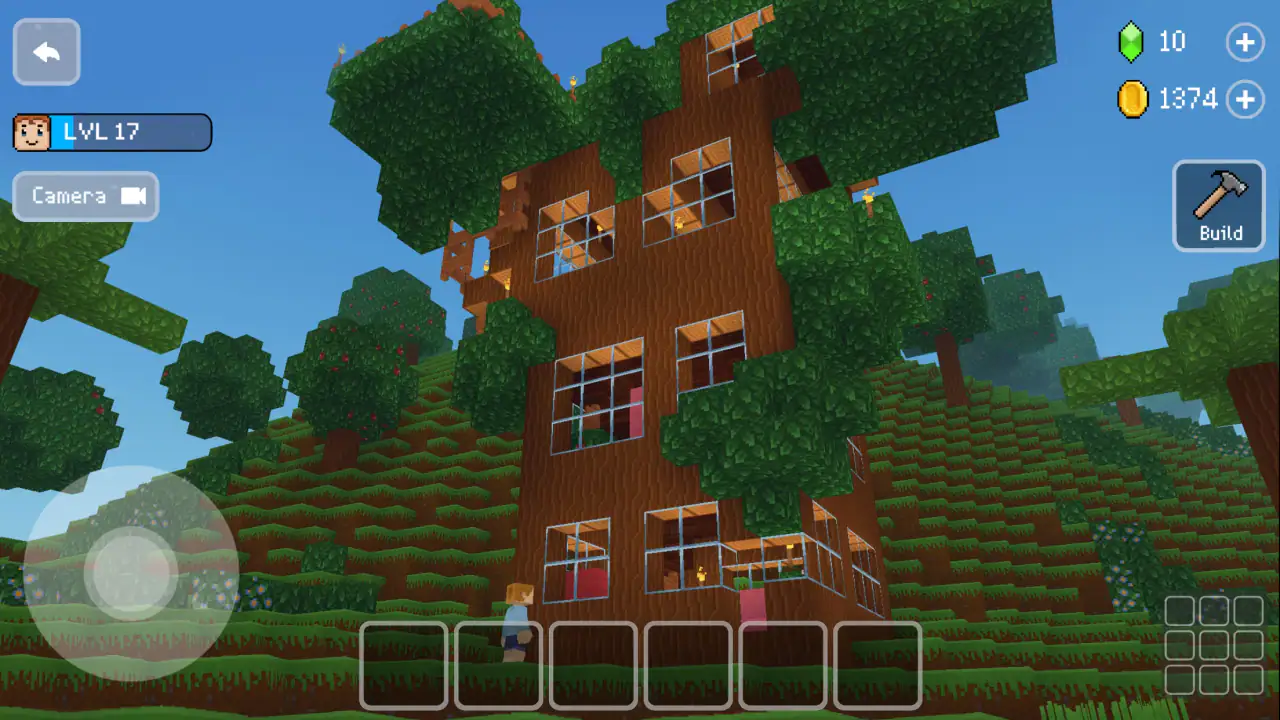
I recommend taking screenshots of a project before making major changes. This is not because the game requires a formal design process; it is simply a practical way to compare versions when a new roof, extension, or decoration does not work as expected. I also found it helpful to build the exterior first, then return to interior details. Trying to perfect both at once made the process feel slower and made it harder to judge the overall shape.
Another small but valuable technique is to leave visual breathing room. A city made entirely of buildings can lose its sense of scale, while open areas help important structures stand out. Roads, gaps, and empty plots become part of the composition. This is where the game can become more thoughtful than its casual presentation suggests: the player is not only stacking blocks but also managing attention across a shared landscape.
That creative freedom is also its first limitation. Players who need clearly defined missions may wonder what they are supposed to do after the first few projects. The answer is largely self-directed construction. If I need a constant stream of objectives, puzzles, or competitive matches, another arcade title may hold my attention better.
What remains enjoyable after the first month
The longer-term value depends on whether I can create personal goals. During the first month, I would not judge the game only by how quickly it gives me new things to place. I would ask whether my city is becoming more coherent and whether I still have a reason to return to unfinished projects. A self-made district, a themed collection of buildings, or a gradual redesign can provide that reason.
I found recurring value in treating the city as a series of manageable projects. Instead of attempting an enormous build, I could finish one street corner, improve one facade, or create a transition between two areas. This approach reduces the feeling that the game is asking for endless work. It also gives each session a visible result, which matters when playing in short bursts.
The game is a particularly good match for players who enjoy revisiting their own creations. Someone who likes the satisfaction of looking back at an old drawing or reorganizing a virtual room may appreciate the same slow accumulation here. The reward is not just unlocking or completing something; it is seeing a rough idea become a place with a consistent identity.
However, the month-to-month experience can become repetitive if every project follows the same pattern. Building a house, then another house, and then a larger house may not feel meaningfully different unless I introduce a new theme or challenge myself to use space more intelligently. I had to create variety deliberately, such as switching between functional-looking buildings and unusual landmarks, rather than waiting for the game alone to provide it.
For that reason, I would use a rotating project list. One session could focus on a compact building, another on improving the area around it, and a later session on correcting an older design. This gives the game a light routine without turning it into a chore. It also helps answer a common question: is it worth returning to after the novelty disappears? My answer is yes, but mainly for players willing to bring their own design ideas.
The real maintenance burden
Maintenance in this game is not the same as managing a demanding simulation. I did not approach it as a city that needed constant supervision. The burden comes from attention: remembering which areas need improvement, keeping a large project organized, and resisting the urge to expand before the current section feels finished.
That distinction matters for casual players. If I leave the game for a while, I am not returning to a complicated spreadsheet of tasks. I can simply choose a building and continue. This makes the game less intimidating than deeper city-management alternatives, where population, resources, traffic, and long chains of dependencies can turn a relaxing session into administration.
At the same time, a large personal city can become harder to manage visually. Once several structures compete for attention, I may forget why I placed them or how they were supposed to connect. A simple naming habit outside the game, such as keeping a short note about the next building or neighborhood idea, can prevent aimless sessions. It sounds excessive for a casual game, but it helped me return with a clear purpose.
The free-to-play model is another part of the maintenance question. The game is free to download, but in-app purchases range from $0.99 to $119.99 per item. I would be careful here, especially if a child is using the device. The Teen content rating is worth noting, and anyone sharing a phone or tablet should review purchase controls before handing it over. I never consider optional spending a substitute for good game design, so I recommend deciding in advance whether I am willing to spend anything at all.
That price range also changes how I evaluate progress. If I feel pressured to pay simply to keep a creative session moving, the relaxed appeal weakens. I prefer using the free experience as a complete trial: play long enough to understand the building loop, then decide whether the pace feels comfortable without purchases. The game makes more sense as a casual creative space than as something that should be rushed.
Where fatigue begins
The biggest source of fatigue is repetition without a personal project behind it. The placing itself is pleasant, but it cannot carry every session indefinitely. Once I stopped thinking about the identity of my city, I began to notice the routine more clearly. The same basic act can feel calming one day and mechanical the next.
There is also a precision issue. Touchscreen building is convenient, but it is not as exact as working with a mouse or a dedicated construction interface. Small corrections can take patience, particularly when I am trying to make a facade symmetrical or work in a tight space. Players who enjoy meticulous architectural control may find the mobile format limiting compared with more advanced sandbox builders.
Another possible frustration is the gap between imagination and execution. I can picture an impressive landmark, yet translating that idea into blocks requires planning and repeated adjustments. The game gives me room to create, but it does not remove the design work. That is a strength for creative players and a weakness for anyone expecting instant polished results.
I also would not recommend it as the main choice for someone seeking a traditional arcade structure. There is no reason to approach it like a score-chasing game where every second matters. A player looking for rapid rounds, reflex tests, or constant action would probably be happier elsewhere. Likewise, fans of deep city simulations may want systems that model economics, transport, citizens, or long-term planning in more detail.
The better alternative depends on what I want from the category. For a more demanding construction sandbox, I would look for a game with finer controls and broader management systems. For a competitive arcade experience, I would choose something built around short matches or high scores. This title sits between those expectations: it offers the accessibility of a casual mobile game while borrowing the satisfaction of making a small virtual city.
Who should keep it installed?
I think it earns a lasting place on a device for players who enjoy gentle, self-directed creativity. It is especially suitable for someone who wants to build in short sessions, return to an evolving environment, and judge progress by personal taste rather than a leaderboard. The low entry barrier is a genuine advantage, and the city format gives individual buildings more context than a collection of disconnected levels.
It is also a good choice for families who want to understand the appeal before deciding whether spending is appropriate. I would still keep the Teen rating in mind and handle purchase settings responsibly. The free entry point makes trying it straightforward, but the presence of in-app purchases means “free” should not be treated as “without any spending considerations.”
I would skip it if I need a clear ending, a strong narrative, or a deep strategy layer. I would also skip it if I become frustrated by touchscreen precision or if I know that open-ended building games lose their appeal once the first novelty fades. In that situation, a more structured arcade game would provide a clearer reason to return, while a more advanced city builder would offer richer systems to manage.
Performance, version, and everyday practicality
The current version is 3.22.0, and it supports devices running Android 6.0 or later. Those details make it relevant to people using older compatible Android hardware, although the practical experience will still depend on the device itself and how comfortable its screen is for detailed placement. I would leave some storage and battery headroom for any 3D game rather than assuming every older phone will feel equally smooth.
In everyday use, I would play with a simple plan: choose one small target, build it, inspect the surrounding space, and stop before the session turns into unfocused expansion. This keeps the game relaxing and protects it from its own repetition. A ten-minute visit can be worthwhile if it finishes a roofline or improves a street corner; it does not need to produce a dramatic transformation every time.
That routine also answers whether the game has recurring value. It does, but the value is maintenance-friendly only when the player controls the scale. If I keep starting oversized projects, the city becomes an obligation. If I treat it as a collection of small creative decisions, it remains easy to revisit.
My long-term verdict
After the first-week excitement, Block Craft 3D becomes less about discovering what the game can do and more about deciding whether I enjoy returning to my own work. That is a fair test, and in my case the answer is mostly positive. The building loop is approachable, the 3D city gives projects a sense of continuity, and short sessions can still feel productive.
Its lasting weakness is the need for self-motivation. The game cannot guarantee that every visit will feel fresh, especially if I repeat the same building style or expect a constant supply of new objectives. I also think the purchase range deserves careful handling, because a casual creative game should not be allowed to become an unplanned expense.
Wildlife Studios has made an inviting arcade building game rather than a full city-management simulation. That focus is exactly why I can recommend it to a friend who wants a calm, visual project on a phone. Its long-term strength is not endless novelty, but the freedom to keep improving a place at my own pace.
My final recommendation is simple: try it if you like decorating, constructing, and returning to a world that reflects your choices. Start with small districts, use themes to avoid repetition, and decide your spending limits before playing regularly. If you need action, strict goals, or complex simulation systems, choose another game. For everyone else, this free arcade title has enough creative comfort to remain installed well beyond the first curious session.
FAQs for Block Craft 3D:Building Game
What is Block Craft 3D and what can I do in the game?
Block Craft 3D is a sandbox building game where players can construct their own virtual worlds using blocks. Similar to Minecraft, it allows you to build structures, landscapes, and entire cities. You can also explore creations by other players, interact with animals, and complete fun missions to earn rewards.
Is Block Craft 3D free to play, and are there in-app purchases?
Yes, Block Craft 3D is free to download and play. However, it does offer in-app purchases. These purchases include items like coins, gems, and special building blocks that can enhance your gameplay experience by speeding up construction or unlocking exclusive features.
Can I play Block Craft 3D offline, or is an internet connection required?
Block Craft 3D can be played offline, allowing you to build and explore without an internet connection. However, certain features, such as visiting other players’ villages and accessing community content, require an internet connection to function properly.
Is Block Craft 3D suitable for children, and does it include educational content?
Block Craft 3D is suitable for children and is rated for ages 4 and up. It offers a creative platform that encourages imagination and problem-solving, although it doesn’t include specific educational content. Parents should be aware of in-app purchases and ensure that playtime is supervised if necessary.
How does the game handle player interaction, and is it safe for kids?
Player interaction in Block Craft 3D is limited to visiting and viewing each other's creations. There is no chat function, making it relatively safe for kids. The game focuses on creativity and exploration without exposing young players to inappropriate content or interactions.
Pros
- User-friendly interface
- easy for beginners.
- Wide variety of building blocks available.
- No requirement for internet connection.
- Regular updates with new features.
- Interactive community for sharing creations.
Cons
- In-app purchases can be expensive.
- Ads can be intrusive during gameplay.
- Limited customization for avatars.
- Graphics may not appeal to everyone.
- Some features require real money.


